

🔐 Introduction:
You’re building fast. Hiring faster. Shipping features weekly. But while your startup pushes for growth, attackers are looking for the cracks, and they’ll find them if you’re not thinking about information security early and often.
Often, Startups are prime targets for cyberattacks because they:
- Collect and process valuable data
- Use third-party tools
- Lack formal security teams
- Delay building secure practices
Let’s break down the 7 biggest security mistakes startups make and what you can do today to avoid them.
⚠️ 1. No Access Control Policy
Startups often give everyone access to everything—fast, but dangerous.
Fix:
- Implement role-based access control (RBAC)
- Use the principle of least privilege
- Revoke access when employees leave or change roles
⚠️ 2. Weak Password Hygiene
Using weak or shared passwords puts your entire system at risk.
Fix:
- Enforce strong password policies
- Require multi-factor authentication (MFA)
- Use password managers like 1Password or Bitwarden
⚠️ 3. No Incident Response Plan
A breach isn’t if—it’s when. Without a plan, you’ll panic, lose time, and damage trust.
Fix:
- Create a simple incident response playbook
- Assign roles and responsibilities
- Run a tabletop simulation quarterly
⚠️ 4. Ignoring Vendor Risk
If one of your tools gets breached, your customers may still blame you.
Fix:
- Maintain a list of all vendors and the data they access
- Prioritize vendors handling sensitive data
- Ask for SOC 2 or ISO 27001 reports when possible
⚠️ 5. Shadow IT (Unapproved Tools)
Employees often use unapproved tools without IT’s knowledge, increasing the attack surface.
Fix:
- Set clear guidelines on approved tools
- Educate your team about the risks of unauthorized apps
- Regularly audit SaaS usage with tools like Blissfully or Torii
⚠️ 6. No Security Awareness Training
Your employees are your first and weakest line of defence.
Fix:
- Run quarterly security awareness training
- Teach staff how to spot phishing emails
- Reward good security behaviour
⚠️ 7. Not Planning for Compliance
You’re storing customer data. Regulators and customers will come knocking.
Fix:
- Identify which regulations apply (SOC 2, CPPA, GDPR, NDPR, etc.)
- Start building your compliance roadmap
- Use simple frameworks like NIST CSF or CIS Controls as a foundation
💡 Summary Table: Security Mistakes vs Solutions
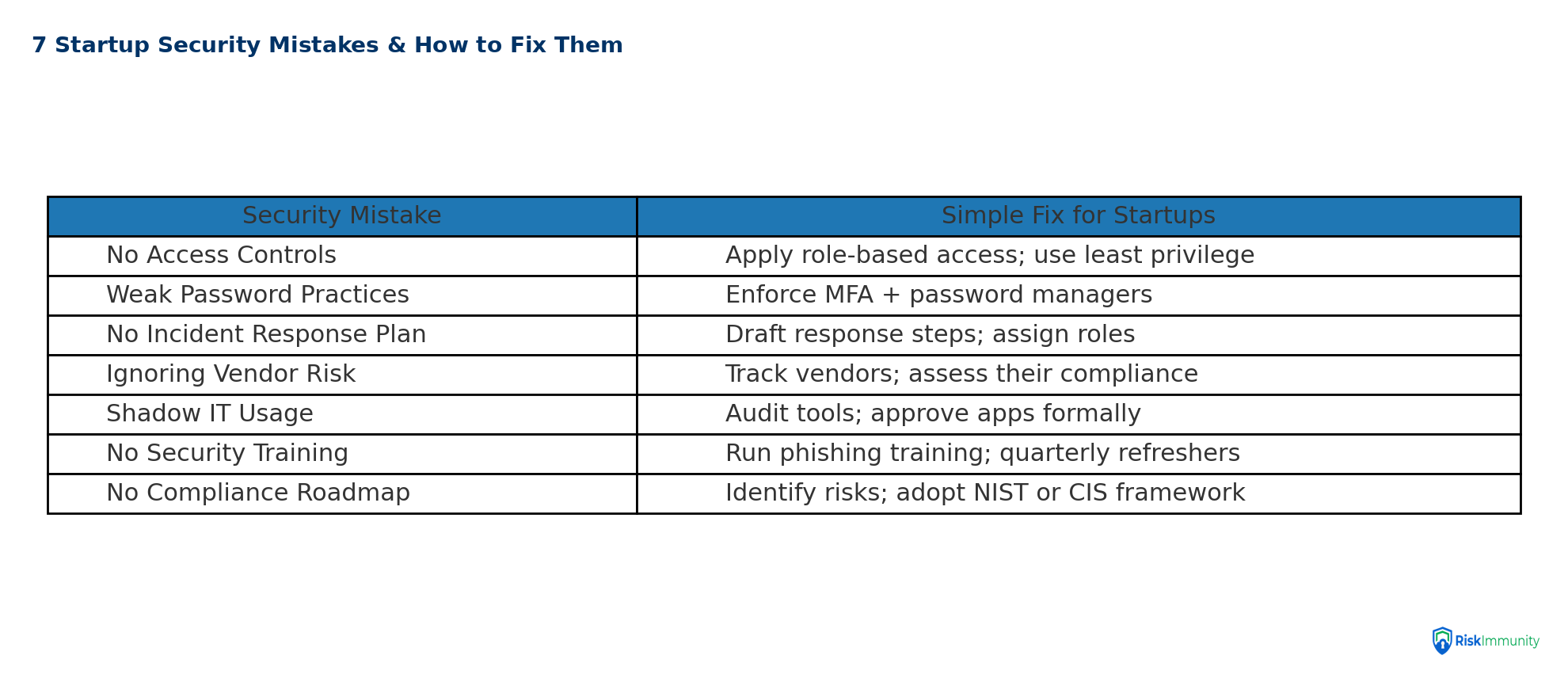
Startups are prime targets for cyberattacks. Here are 7 common InfoSec mistakes growing companies make and practical, low-cost solutions to stay secure and resilient.
🚀 Final Thoughts:
Startups don’t need a full-blown security team to be secure. They just need to start small, stay consistent, and build security into their growth, not bolt it on later.
✅ Call to Action:
Want to bulletproof your security posture without hiring a CISO?
📩 Schedule a free InfoSec Risk Review with https://www.riskimmunity.com, and we’ll help you identify quick wins and build a practical roadmap.


